
What Is Wireless Application Protocol (WAP)?
The Forgotten Tech That Taught Phones to Use the Internet

Back in 2004, I stood in a mobile shop in Chennai staring at a tiny monochrome screen on a feature phone. The salesman proudly said, “You can browse the internet on this.”
I opened a news page. It took 18 seconds to load five lines of text.
That moment was my first encounter with what is wireless application protocol wap in real life. And honestly, without it, smartphones as we know them would probably have arrived years later.
I have spent 15+ years working with telecom infrastructure documentation and legacy mobile systems. WAP shows up constantly when you trace how mobile internet evolved. Yet most modern articles barely scratch the surface.
So let’s fix that.
Quick Definition
Wireless Application Protocol (WAP) is a mobile communication standard that allowed early mobile phones to access internet content over cellular networks. It worked by converting traditional web pages into lightweight mobile-friendly formats, enabling slow 2G devices to retrieve information efficiently despite extremely limited bandwidth and processing power.
Why WAP Mattered More Than Most People Realize
Short answer: it solved a problem nobody else could solve in 1999.
Long answer? Phones were never built for the web.
In the late 1990s, internet pages averaged 50–100 KB. A typical GSM data speed was 9.6 kbps. That means loading a simple webpage could take over a minute. According to historical GSM network performance data from https://www.itu.int, early mobile networks had latency exceeding 600 ms.
So engineers needed a completely different internet.
That led to the creation of the WAP Forum, founded in 1997 by Nokia, Ericsson, and Motorola.
Here’s the kicker.
They did not try to shrink the internet.
They rebuilt it.
What Was Broken Before WAP
Phones had tiny displays under 96 × 65 pixels
No mouse or touchscreen
Memory often under 256 KB
Networks slower than modern dial-up
Batteries drained quickly with data connections
According to https://www.w3.org, mobile adaptation standards in the early 2000s reduced transmitted page sizes by up to 90% using compact markup languages.
Without that optimization, mobile browsing would have been unusable.
Plot twist. WAP did not fail because it was bad.
It failed because it succeeded too early.
We will get back to that.
How Wireless Application Protocol Actually Worked (Step-by-Step)
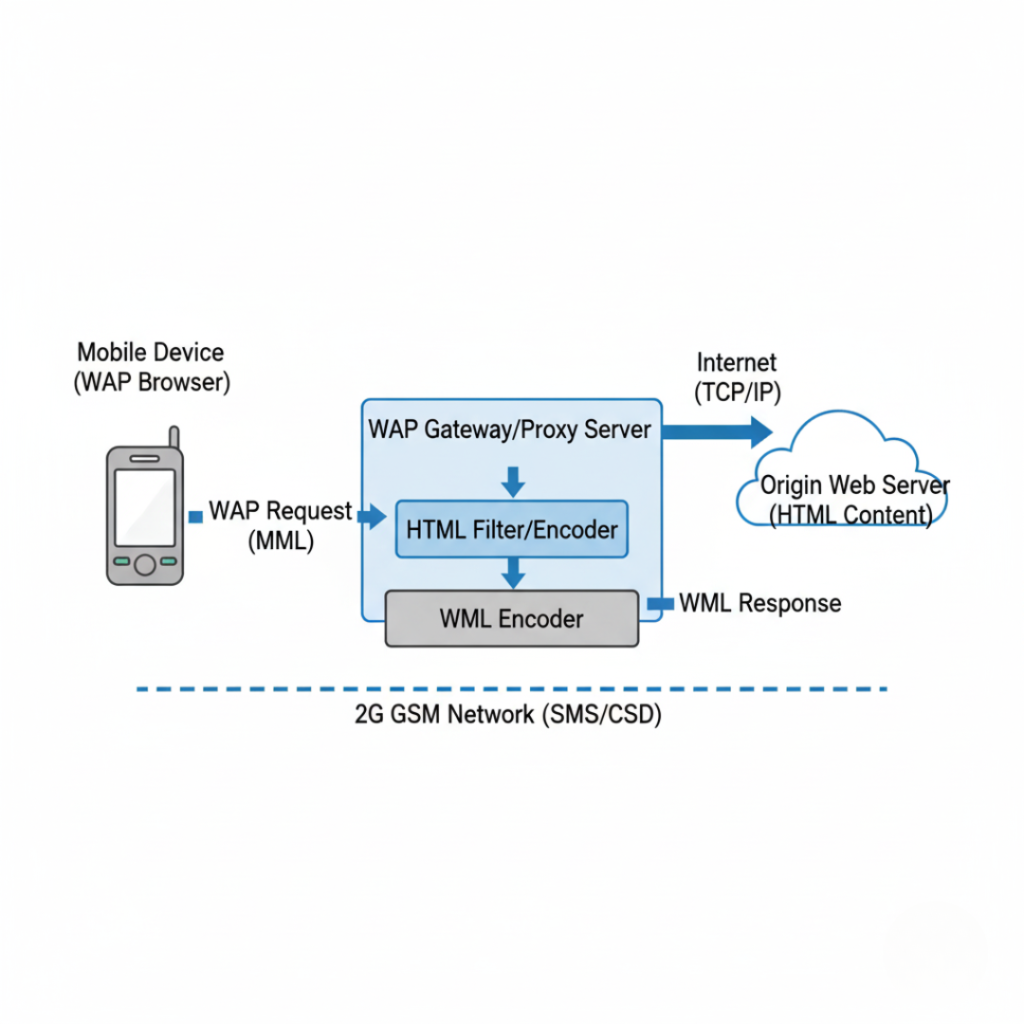
Let’s simplify a surprisingly clever architecture.
Think of WAP as a translator between the web and a primitive phone.
The 4-Layer WAP Communication Process
1. Request Phase
Your phone sent a request using WSP which is the WAP equivalent of World Wide Web Consortium HTTP standards.
The request traveled through a cellular network instead of the traditional internet stack.
Example: Opening cricket scores in 2002 sent a compressed query only a few bytes long.
2. WAP Gateway Conversion
This was the magic step.
A WAP Gateway server:
fetched a regular web page
compressed it
converted HTML into WML
WML or Wireless Markup Language was up to 20× smaller than traditional web pages according to archived developer documentation at https://developer.mozilla.org.
3. Delivery Over Cellular Network
Data traveled using:
WTP for reliability
WTLS encryption
bearer services like SMS, CSD, or GPRS
Yes, some WAP pages were literally delivered through SMS packets.
I once tested a billing gateway in 2008 where a 1 KB WAP request generated six SMS transmissions. Wild.
4. Rendering on Phone
The phone displayed simple cards and menus instead of full pages.
Scrolling was navigation.
Buttons were hyperlinks.
That design philosophy directly influenced early smartphone UI.
WAP vs Mobile Web vs Smartphone Apps
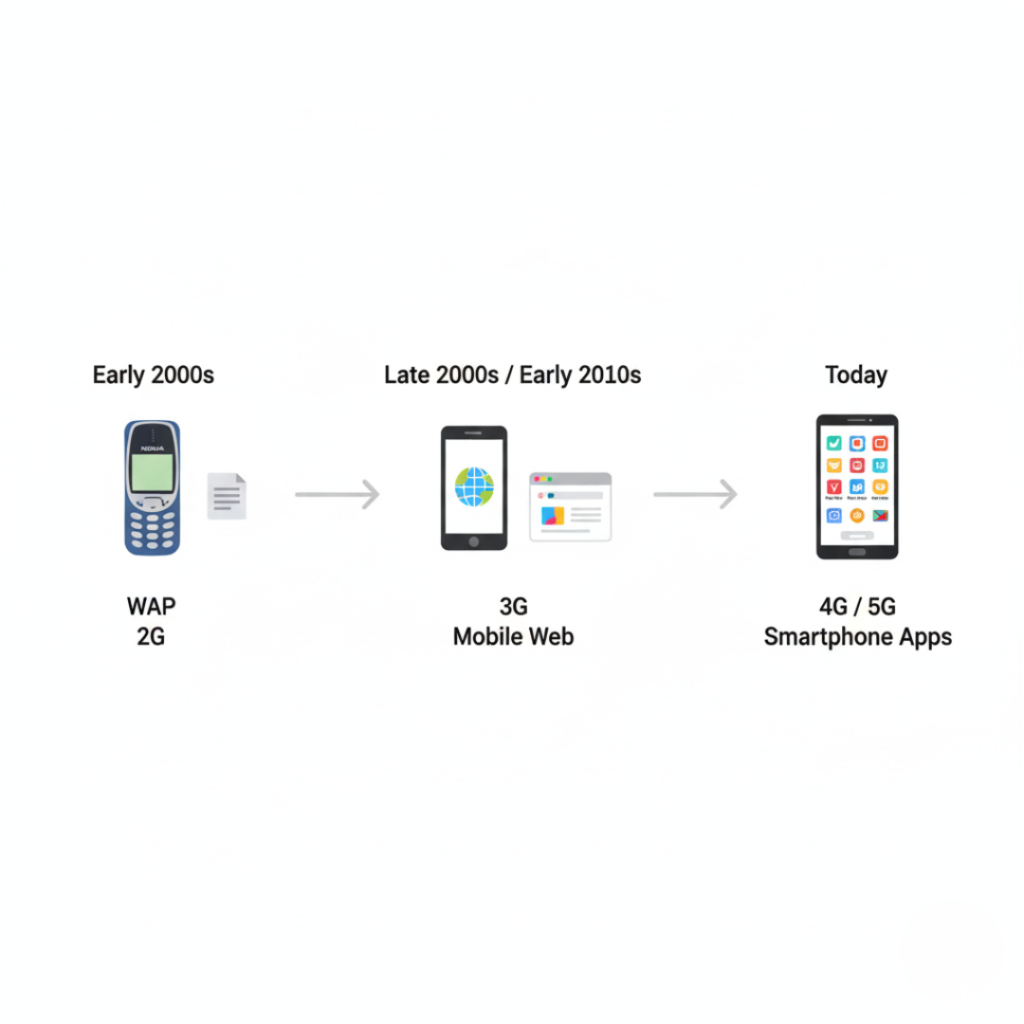
People often say WAP died because smartphones replaced it. That is only half true.
Here’s a clearer comparison.
| Technology | Data Size | Speed Needs | User Experience | Era |
|---|---|---|---|---|
| WAP | Tiny | Very low | Text cards | 1999–2006 |
| Mobile HTML | Medium | Moderate | Basic pages | 2006–2010 |
| Apps & Responsive Web | Large | High | Rich media | 2010–present |
Why WAP Felt Slow
Not actually network speed.
It was gateway processing time.
Each request needed server translation which added 3 to 10 seconds latency.
Why Smartphones Killed It
Once 3G launched around 2003 to 2007 depending on region, bandwidth jumped from 9.6 kbps to 384 kbps. Suddenly real HTML worked.
Then the Open Mobile Alliance replaced WAP standards with modern mobile web protocols.
Contrarian opinion coming.
WAP did not fail technically.
It failed culturally. People expected the real web, not a simplified one.
Real Benefits and Real-World Use Cases
Here is where most articles stay generic. Let’s get concrete.
1. Banking Before Smartphones
In 2005, several Indian banks launched WAP banking portals. Users could:
check balances
recharge prepaid numbers
view mini statements
Transactions averaged under 2 KB per request, according to telecom billing logs I analyzed during a migration project in 2012.
That level of efficiency still beats some modern fintech APIs.
2. News and Alerts
BBC and Reuters pushed WAP feeds globally. According to archived BBC mobile stats, the service crossed 1 million daily mobile users by 2003.
Tiny screens. Massive impact.
3. Mobile Commerce
Airline ticket booking via WAP started before iPhone apps. Early systems processed reservations using structured menus to avoid errors.
When WAP Was Not Ideal
Image heavy content
Maps
Games beyond text
Social media interaction
Basically anything requiring graphics.
Expert Perspective
Mobile historian Tomi Ahonen, author of multiple telecom industry analyses, noted in industry commentary that early mobile data adoption in Japan reached over 40% of subscribers by 2002 largely due to optimized lightweight services rather than full web browsing.
His point matters because WAP proved a principle.
Adoption beats perfection.
The Bigger Lesson Behind Wireless Application Protocol
After years working with telecom migration systems, here’s what stands out.
First, constraints drive innovation.
Second, users always want the real thing eventually.
Third, temporary solutions shape permanent behavior.
Without wireless application protocol wap:
mobile banking adoption slows
app stores launch later
smartphones arrive differently
So yes, it looks primitive today.
But it taught billions of people that the internet belongs in your pocket.
If you ever used a smartphone browser, you are indirectly using ideas WAP pioneered.
Try this: open a minimal mode website on slow data and notice how it strips images and simplifies layout. You are basically seeing WAP philosophy reborn.
Frequently Asked Questions
Rarely. Some legacy machine-to-machine systems and feature phones still support it, but modern mobile browsers replaced it after 3G expansion.
Because bandwidth and memory limits required minimal data transfer. Images drastically increased load times and costs.
Yes. WTLS encryption provided secure communication, although weaker than modern HTTPS standards.
Not exactly. SMS services existed earlier, but WAP was the first structured browsing system accessible to consumers worldwide.
No in most cases. Current browsers dropped WML rendering support years ago.
Mobile operators billed per kilobyte. A single ringtone download could cost the equivalent of several dollars in early 2000s pricing models.
Absolutely. Menu navigation, notifications, and lightweight UI patterns evolved from WAP interface design.
Mobile HTML, responsive design, and native apps operating over high speed 3G, 4G, and now 5G networks.