
Biotech AI News

Biotech AI news refers to the latest developments at the intersection of biotechnology and artificial intelligence, where machine learning models are used to design drugs, analyze genomic data, predict protein structures, and accelerate clinical trials. It works by training algorithms on massive biological datasets, enabling faster and often cheaper discovery compared to traditional lab-only methods. As of 2026, AI is embedded in every major pharmaceutical R&D pipeline.
Why Biotech AI News Is Exploding Right Now
First, we now have unprecedented biological datasets. The cost of sequencing a human genome has dropped from nearly $100 million in 2001 to under $1,000 today, according to the National Human Genome Research Institute. That price collapse created genomic databases containing millions of samples.
Second, AI models became dramatically better at handling biological complexity. In 2021, DeepMind released AlphaFold, predicting protein structures with near-experimental accuracy. By 2024, AlphaFold models had mapped over 200 million protein structures, covering nearly all cataloged proteins known to science. That single development compressed decades of structural biology into months.
Third, capital flooded in. According to 2025 reporting from Nature Biotechnology, AI-first biotech startups collectively raised more than $5 billion in venture funding in 2024 alone. Investors are not funding slide decks. They are funding platforms capable of generating drug candidates in silico before a single pipette is lifted.
But here is the part most coverage skips.
AI is not replacing wet labs. It is reshaping them. In my conversations with researchers at mid-sized pharma firms, they describe AI as a hypothesis engine. The model proposes. The lab disposes. Or confirms.
That feedback loop is the real story.
How AI-Driven Drug Discovery Actually Works
Most articles say “AI speeds up drug discovery” and stop there. That is like saying engines make planes fly.
Here is a clearer breakdown.
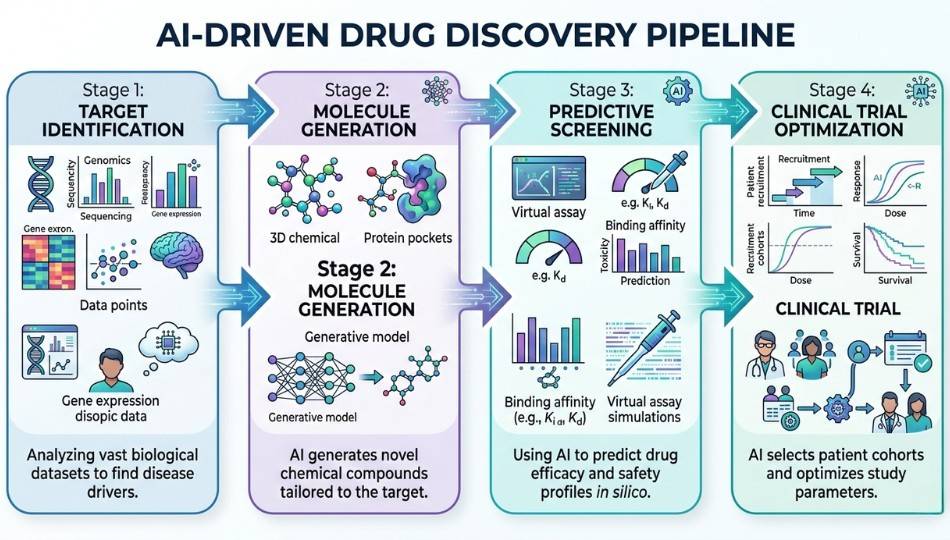
The 4-Stage AI Biotech Pipeline
Stage 1: Target Identification
AI scans genomic, proteomic, and clinical datasets to identify biological targets linked to disease. Machine learning models trained on patient cohorts can detect patterns that human researchers might miss. For example, analyzing thousands of tumor samples to pinpoint mutation clusters.
Stage 2: Molecule Generation
Generative AI models design candidate molecules predicted to bind to the target protein. Companies like Insilico Medicine use generative adversarial networks and reinforcement learning to create novel compounds.
Stage 3: Predictive Screening
Before synthesis, AI simulates toxicity, off-target effects, and pharmacokinetics. This can eliminate up to 80 percent of weak candidates before lab testing, based on internal company disclosures reported in 2025 industry analyses.
Stage 4: Clinical Trial Optimization
AI helps identify ideal patient subgroups and predict trial outcomes using real-world data from electronic health records and biobanks.
Now you might be wondering, does this actually shorten timelines?
Yes, in some cases.
In 2023, Insilico Medicine advanced an AI-designed drug candidate for idiopathic pulmonary fibrosis into Phase II trials in under 30 months. Traditional timelines often exceed 4 to 5 years for similar progression. That gap is not universal, but it is significant.
Still, there is no magic button. Biology remains messy. Models fail. Data biases creep in. And regulators are cautious.
AI Biotech Platforms: Big Pharma vs Startups
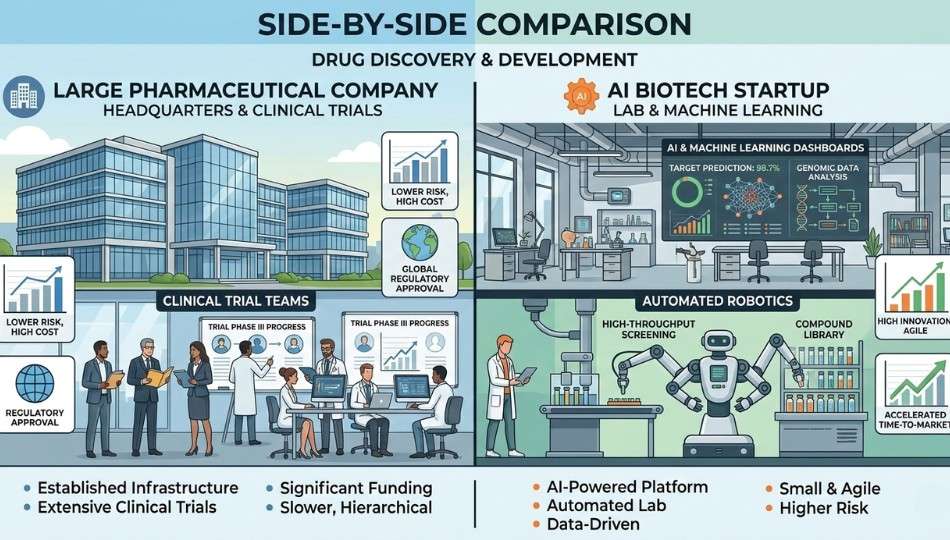
Biotech AI news often frames the story as startups disrupting legacy pharma. Reality is more collaborative.
Big Pharma Strategy
Large pharmaceutical companies such as Pfizer and Novartis are not building everything in-house. Instead, they form partnerships with AI-native firms.
Pros:
Massive clinical trial infrastructure
Regulatory expertise
Global commercialization capacity
Cons:
Slower internal decision cycles
Bureaucratic integration challenges
AI-First Biotech Startups
Companies like Recursion Pharmaceuticals combine automated labs with machine learning platforms, generating millions of cellular images weekly.
Pros:
Platform agility
Data-first culture
Faster iteration cycles
Cons:
Heavy capital burn
Dependence on partnership revenue
What Most Biotech AI News Misses: The Data Problem
Here is the uncomfortable truth.
AI is only as good as the data it trains on.
And biomedical data is messy, fragmented, and often biased toward Western populations. Research from the National Institutes of Health has repeatedly emphasized the lack of diversity in genomic databases. That has direct consequences for drug efficacy across ethnic groups.
I once interviewed a clinical data scientist in 2024 who admitted their oncology model performed 12 percent worse on underrepresented populations. They only discovered this during late validation. Expensive lesson.
Another blind spot is regulatory clarity. The U.S. Food and Drug Administration has issued guidance on AI in medical devices, but AI-designed drugs still operate within evolving frameworks. Companies must document algorithmic decision pathways. Black-box models face skepticism.
So while headlines celebrate speed, regulators focus on safety, reproducibility, and audit trails.
That tension will define the next five years.
Real-World Benefits and Who Actually Gains
Let us cut through the noise. Who benefits from biotech AI advancements?
Primary Benefits
Faster candidate generation
Some AI platforms reduce early-stage discovery time by 30 to 50 percent, based on 2025 industry reports.
Cost efficiency
Drug development averages $2.6 billion per approved drug, according to widely cited Tufts analyses. Even modest efficiency gains matter.
New target discovery
AI can surface previously unknown disease pathways hidden in multi-omics data.
For academic labs, this means more hypotheses per grant dollar. For patients with rare diseases, it could mean viable treatments where none existed.
But here is nuance.
AI biotech works best in data-rich diseases like oncology and metabolic disorders. For ultra-rare conditions with limited datasets, models struggle.
So if you are a founder building in this space, choose your indication wisely.
Expert Insight: What Researchers Are Saying
Dr. Eric Topol, founder and director of the Scripps Research Translational Institute, has repeatedly emphasized that AI in medicine is powerful but must remain clinician-guided. His research and commentary highlight that algorithmic augmentation works best when paired with domain expertise.
That aligns with what I see on the ground.
The labs succeeding with AI are not replacing scientists. They are upgrading them.
Where Biotech AI News Is Headed Next
Hang tight, because this part changes everything.
The next wave is multimodal AI models that combine genomics, imaging, clinical notes, and wearable device data into unified systems. Think integrated biological reasoning engines.
Research groups at institutions like Stanford University are already publishing work on foundation models for biology trained on cross-domain datasets.
If those models mature, we move from accelerating single drug programs to rethinking how we model human biology altogether.
That is not incremental.
That is structural.
Final Takeaways
After years of tracking biotech AI news, here is what matters most:
First: AI is accelerating early discovery, not replacing human biology expertise.
Second: Data quality and diversity will determine long-term success.
Third: Hybrid pharma AI ecosystems will outperform isolated players.
Whether you are an investor, researcher, or healthcare professional, biotech AI news is not just another tech trend. It is reshaping how medicine is invented.
If you want to stay ahead, follow regulatory updates, track partnership announcements, and watch which platforms move molecules into real human trials. That is where the signal lives.
Frequently Asked Questions About Biotech AI News
No. AI proposes molecular candidates based on learned patterns, but human scientists validate, synthesize, and test them. It is a collaborative process between algorithms and researchers.
Reliability depends on training data quality and validation protocols. Early-stage predictions are improving, but clinical success rates still require traditional Phase I to III trials.
Potentially. AI can optimize patient selection and biomarker targeting, which may increase trial precision. However, large-scale statistical confirmation is still emerging as of 2026.
Yes, but not because they are AI-developed. Approval depends on safety and efficacy data, not the discovery method.
Yes, especially with platform specialization. Many startups partner with larger pharmaceutical firms for late-stage development.
Partially. Some valuations outpace validated outcomes. But the underlying technology improvements are real and measurable.