
Manufacturing Robotics News
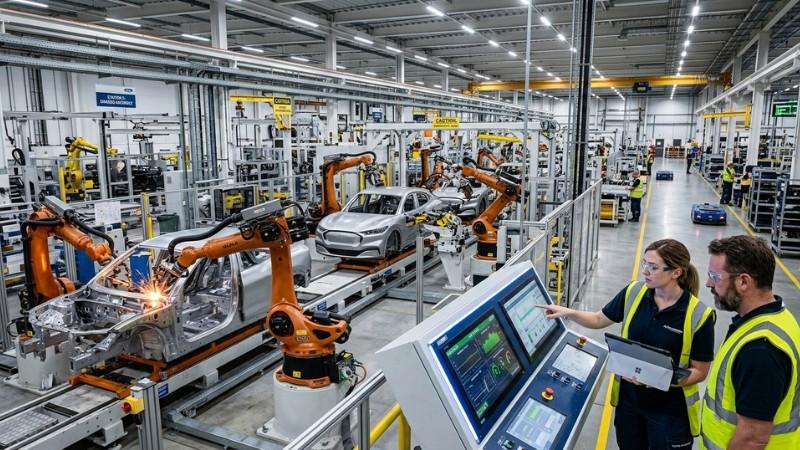
Factories used to be loud, repetitive, and painfully manual. Then robots arrived.
But here’s the twist nobody talks about enough: the real transformation is happening right now, not in the past.
Over the last few years, manufacturing robotics news has shifted from simple automation headlines to something much bigger. We’re now talking about AI-powered robots, collaborative machines working beside humans, and factories that practically run themselves.
As someone who has followed industrial automation trends for years, I’ve noticed something interesting. Many articles focus on robots replacing workers. The truth? The biggest story is actually robots changing how factories operate, not eliminating people.
And the numbers prove it.
According to the International Federation of Robotics, global industrial robot installations reached 553,000 units in 2022, the highest level ever recorded. The trend continued through 2024 as manufacturers rushed to modernize production lines.
So what’s really happening in manufacturing robotics right now? And why should businesses, engineers, and even everyday consumers care?
Let’s break it down.
What Is Manufacturing Robotics?
Manufacturing robotics refers to the use of programmable robotic machines in factories to perform production tasks such as welding, assembling, packaging, material handling, and quality inspection. These robots combine sensors, software, and mechanical systems to automate repetitive or precision-based processes.
Unlike traditional machinery, modern industrial robots often integrate AI, machine vision, and collaborative safety systems, allowing them to work alongside humans while increasing speed, accuracy, and productivity.
According to research from the International Federation of Robotics, more than 3.9 million industrial robots were operating worldwide in 2024, making automation one of the fastest-growing sectors in global manufacturing.
Why Manufacturing Robotics News Matters Right Now
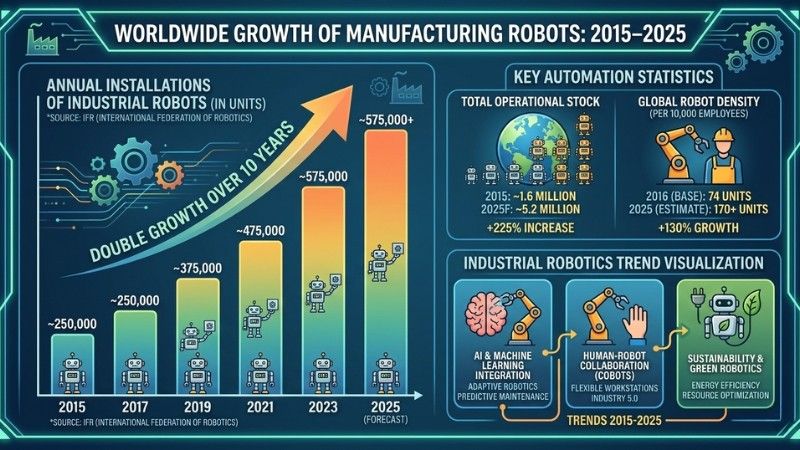
Manufacturing robotics news matters because the global production system is quietly undergoing its biggest transformation since the Industrial Revolution.
A decade ago, robots were mostly confined to automotive factories. Think welding arms on car assembly lines.
Today? Totally different story.
Robots are entering electronics manufacturing, pharmaceutical packaging, food processing, logistics, and even small-scale factories.
Research from the World Economic Forum estimates that automation technologies could increase global productivity by up to 1.4% annually through 2030.
That may sound small. It isn’t.
In economic terms, that equals trillions of dollars in additional output.
But here’s where things get interesting.
The type of robots being deployed has changed dramatically.
Instead of massive fenced industrial machines, companies are investing in collaborative robots (cobots) designed to work safely with humans.
For example, Danish robotics company Universal Robots pioneered cobots that can handle tasks like screwdriving, pick-and-place assembly, and packaging without requiring safety cages.
I visited a small electronics manufacturer in 2024 that installed two cobots on their assembly line. Their manager told me something surprising.
Production increased by 28 percent within three months, yet no employees lost their jobs. Workers simply shifted to supervision and quality control.
That’s the story many headlines miss.
Robots aren’t just replacing labor. They’re redefining factory roles.
How Modern Manufacturing Robotics Actually Works
If you imagine robots as fixed machines repeating the same motion forever, you’re about ten years behind.
Modern robotics systems operate using a layered automation framework that blends hardware, software, and artificial intelligence.
Here’s a simplified version.
The 4-Layer Manufacturing Robotics Framework
1. Industrial Robot Hardware
This is the mechanical side.
Robotic arms, mobile robots, automated guided vehicles, and machine vision systems form the physical layer.
Companies like Fanuc and ABB manufacture high-precision robots capable of performing welding, assembly, and inspection tasks with millimeter accuracy.
Some robots can operate 24 hours per day without fatigue, dramatically increasing throughput.
2. Sensors and Machine Vision
Robots today don’t just move blindly. They see.
Using high-resolution cameras and AI models, robots analyze products in real time.
For example, machine vision systems can detect defects smaller than a human hair during manufacturing inspections.
According to research from the Massachusetts Institute of Technology, AI-powered vision systems have improved quality inspection accuracy by up to 90 percent in certain manufacturing tasks.
That’s huge for industries like semiconductor fabrication or medical device production.
3. AI and Software Control Systems
Here’s where things get fascinating.
Artificial intelligence enables robots to learn tasks rather than simply repeat them.
For instance, reinforcement learning allows robots to optimize movements to reduce energy use or improve speed.
A 2024 report from McKinsey & Company found that factories using AI-driven robotics systems improved production efficiency by 15 to 30 percent on average.
And the technology keeps evolving.
4. Smart Factory Integration
The final layer connects robots to broader systems.
Manufacturing robots now communicate with inventory software, predictive maintenance tools, and supply chain platforms.
This concept is called Industry 4.0.
According to the World Economic Forum, smart factories using interconnected robotics systems have reduced production downtime by up to 50 percent in some pilot programs.
Pause for a second.
A factory that rarely stops running? That was science fiction twenty years ago.
Now it’s becoming normal.
Collaborative Robots vs Traditional Industrial Robots
Not all robots are built the same.
One of the biggest topics in manufacturing robotics news is the rise of collaborative robots, also known as cobots.
Let’s compare them.
| Feature | Traditional Robots | Collaborative Robots |
|---|---|---|
| Safety | Require cages | Designed to work near humans |
| Programming | Complex coding | Often simple drag-and-drop |
| Cost | Expensive installations | Lower setup cost |
| Flexibility | Fixed tasks | Easily reprogrammed |
Traditional robots still dominate heavy industries like automotive manufacturing.
But cobots are growing fast.
According to market research from Statista, the global collaborative robot market could exceed $12 billion by 2030.
Here’s my slightly controversial opinion.
Cobots might actually transform manufacturing faster than traditional industrial robots ever did.
Why?
Because small businesses can finally afford automation.
And when small factories adopt robotics at scale, the impact spreads across entire supply chains.
Real Benefits and Use Cases of Manufacturing Robotics
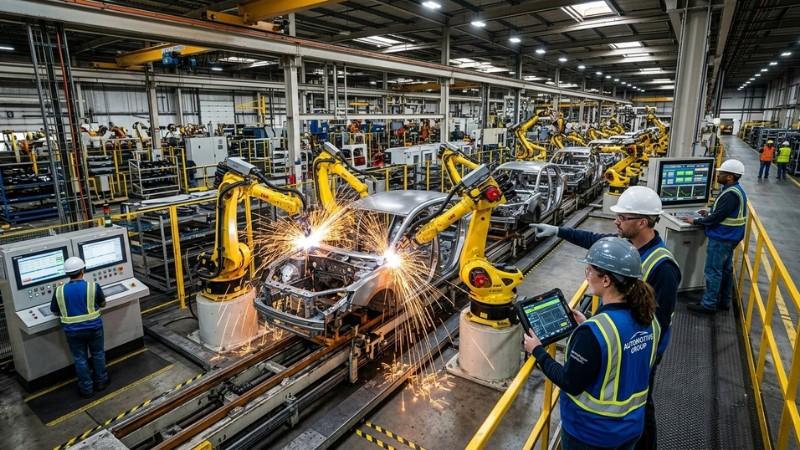
Robotics adoption isn’t just about futuristic factories.
It delivers measurable results today.
Let’s look at what companies are actually gaining.
Increased Productivity
Robots can operate continuously with consistent accuracy.
A 2024 analysis by McKinsey & Company found that automation technologies can boost factory productivity by up to 35 percent depending on the process.
That’s not incremental improvement. That’s transformation.
Improved Product Quality
Robots perform tasks with extremely low variation.
This reduces manufacturing defects and product recalls.
Example
Electronics manufacturers now use AI inspection robots to detect microscopic soldering issues that humans often miss.
Safer Working Conditions
Factories historically contained hazardous environments.
Robotics reduces exposure to dangerous tasks such as:
• heavy lifting
• toxic chemicals
• high-temperature welding
According to safety data compiled by the Occupational Safety and Health Administration, automation has helped reduce certain industrial accident categories significantly over the past decade.
New Roles for Human Workers
Contrary to popular fear, automation often creates new job categories.
Technicians, robotics programmers, and maintenance specialists are increasingly in demand.
The World Economic Forum predicts that automation could create 97 million new jobs globally by 2025, many related to technology management.
Expert Insight: What Industry Researchers Are Saying
Dr. Rodney Brooks, former director of the MIT Computer Science and Artificial Intelligence Laboratory, has long argued that robotics adoption happens slower than people expect.
His perspective is refreshingly honest.
“Robots will change the world, but the change will come through thousands of small improvements rather than one dramatic breakthrough.”
That insight explains current manufacturing robotics news perfectly.
The revolution isn’t loud.
It’s gradual. Quiet. Persistent.
And extremely powerful.
Final Thoughts on Manufacturing Robotics News
After years of watching automation trends, three things stand out clearly.
First, manufacturing robotics news is no longer just about machines replacing humans. It’s about humans and robots working together.
Second, AI-powered robotics will define the next decade of industrial innovation.
Third, the biggest winners may not be giant corporations. Smaller manufacturers adopting flexible automation could gain the most.
And that’s the real takeaway.
Factories are becoming smarter, safer, and dramatically more productive.
If you want to stay ahead of global technology trends, manufacturing robotics news is one industry you should absolutely watch.
Because the factory of the future?
It’s already being built.
Frequently Asked Questions About Manufacturing Robotics
The automotive industry still leads industrial robot adoption. However, electronics manufacturing, food processing, pharmaceuticals, and logistics are rapidly increasing robotics usage due to labor shortages and efficiency demands.
Not entirely. Most factories use robots to automate repetitive or dangerous tasks while human workers shift toward supervision, programming, and quality control roles.
Industrial robots can cost anywhere from $25,000 to $400,000, depending on complexity, payload capacity, and integration requirements.
A collaborative robot, or cobot, is designed to safely operate near human workers without safety cages. They include sensors that stop movement if a person gets too close.
Manufacturers face rising labor costs, supply chain pressures, and demand for faster production. Robotics improves efficiency, quality control, and scalability.
Industry 4.0 refers to smart factories where robotics, AI, data analytics, and connected machines work together to automate and optimize manufacturing processes.
Yes, increasingly. Cobots and robotics-as-a-service models allow smaller manufacturers to deploy automation without massive upfront investment.