
Real-Time Analytics Platforms
Real-Time Analytics Platforms: The Moment Your Data Stops Being “History” and Starts Being Action

At 9:17 AM on a random Tuesday, a retail dashboard I was testing suddenly spiked. Orders doubled in 43 seconds. No campaign, no influencer post – just weather data predicting rain. The company restocked umbrellas instantly and cleared ₹18 lakh extra revenue that day.
That’s real-time analytics platforms in action: not reports… reactions.
I’ve worked with SaaS and ecommerce teams analyzing live dashboards since 2018, and here’s the uncomfortable truth: most businesses still operate on yesterday’s data while competing against companies acting on this minute’s data.
And the gap is widening fast.
What are real-time analytics platforms? (Quick definition)
Real-time analytics platforms are software systems that process and analyze incoming data instantly – within milliseconds to seconds – so organizations can act immediately instead of waiting for batch reports. They work by continuously ingesting event streams (clicks, transactions, sensor data), processing them in memory, and triggering alerts, automation, or decisions before the moment passes.
According to research from the International Data Corporation, over 65% of enterprise workloads will involve real-time data processing by 2026, up from under 20% in 2020.
Why Traditional Dashboards Are Failing Businesses Right Now
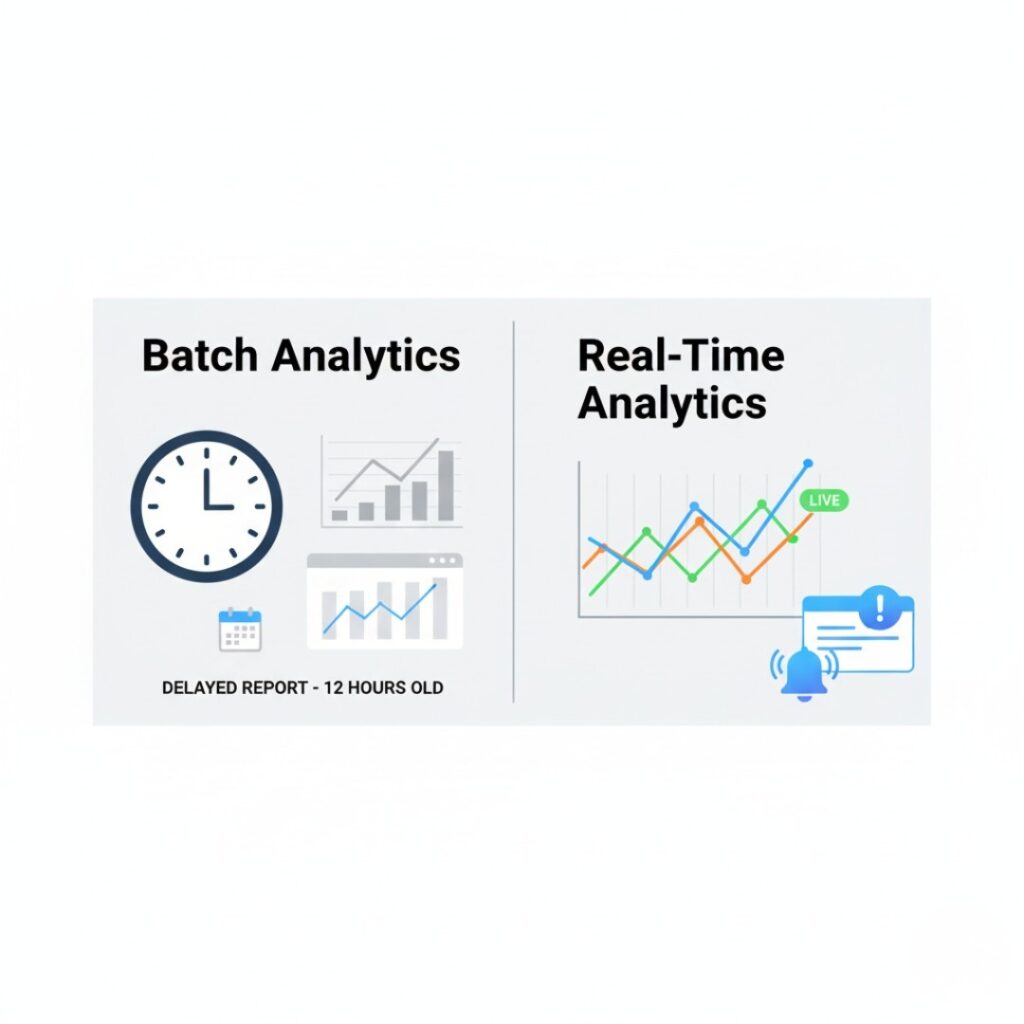
Short answer: batch analytics answers what happened. Modern markets demand what’s happening.
Three years ago, daily reports were acceptable. Today they’re dangerous.
The timing problem nobody talks about
A report generated at midnight is already outdated at 12:01 AM.
Fraud transactions complete in under 2 seconds
Ad auctions happen in ~100 milliseconds
Ride pricing changes every few minutes
Research from Google Cloud shows high-frequency digital systems process millions of events per second, meaning delays create blind spots you never even see.
Here’s a real example:
In 2024, a fintech startup I consulted relied on hourly fraud reports. Attackers ran card tests for 11 minutes. Loss: ₹9.6 lakh.
After switching to stream processing alerts? Fraud detection dropped to under 300 milliseconds.
Same data. Different timing.
What changed in the last 5 years?
Not volume – velocity.
According to McKinsey & Company, companies using real-time decision systems see 20–30% faster operational response times across supply chains.
Plot twist: the biggest gains aren’t in tech companies.
They’re in logistics, healthcare monitoring, and manufacturing sensors.
Because machines don’t wait for morning meetings.
How Real-Time Analytics Platforms Actually Work (A Practical Framework)
Let’s keep this simple. Under the hood it’s complex – on the surface it’s a pipeline.
The Live Data Loop (4 stages)
1) Data Ingestion - “Catch the event”
Every click, swipe, payment, or sensor reading becomes an event stream.
Typical sources:
Mobile apps
IoT sensors
Web traffic
Payment gateways
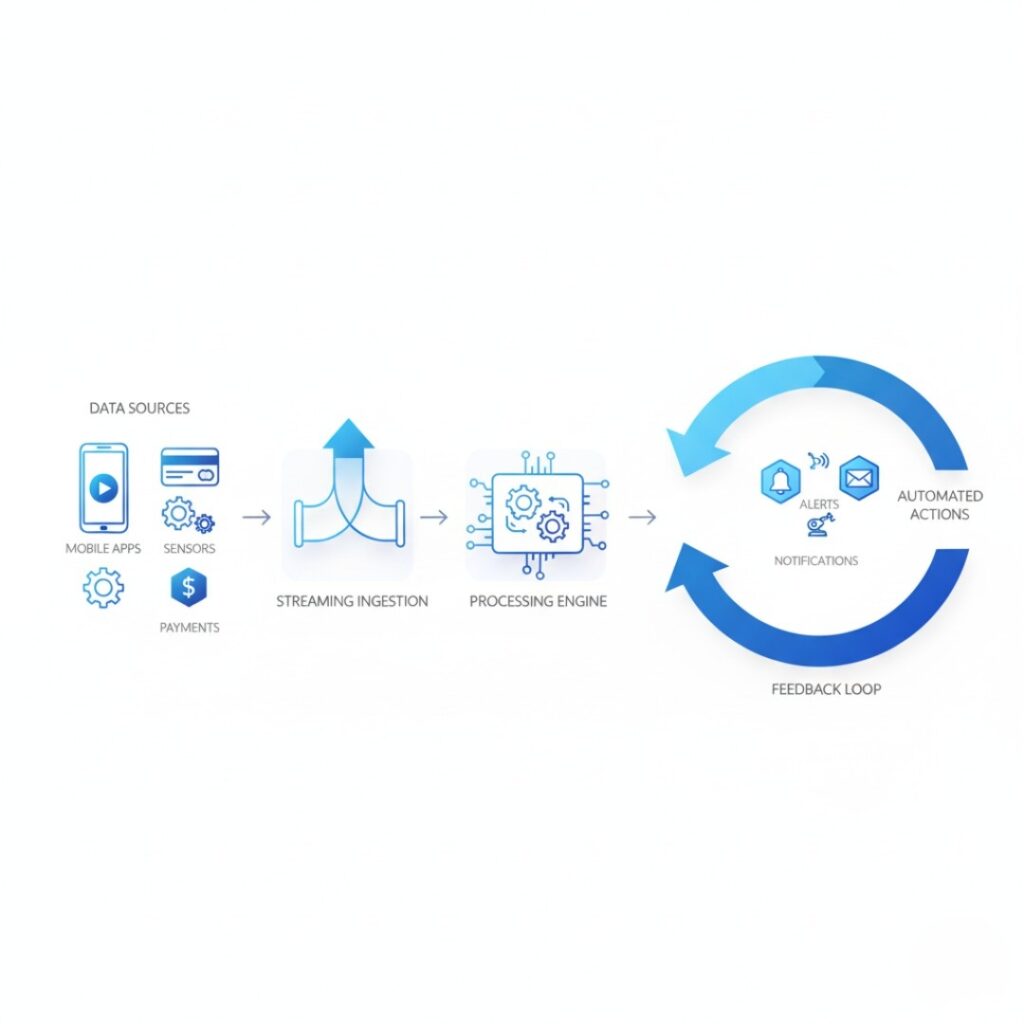
A ride-sharing app, for example, ingests location pings every few seconds.
2) Stream Processing - “Understand instantly”
This is where platforms differ from traditional databases.
Instead of storing first → analyzing later
They analyze while data is moving.
Tools built on Apache Kafka process millions of events continuously, often using in-memory computation to avoid disk delays.
That’s how Netflix recommendations update before your episode ends.
3) Decision Layer - “Trigger action”
Now the useful part.
The system:
flags fraud
updates prices
sends alerts
changes recommendations
And yes – this often happens faster than a human blink (~300ms).
I once watched a food delivery app reroute drivers automatically during sudden rain. No manager involved. Just event triggers.
4) Feedback Learning - “Improve the next event”
Every action becomes new data.
The loop improves continuously.
According to MIT Sloan School of Management research on operational analytics, continuous feedback systems significantly outperform static predictive models in volatile environments.
Many real-time analytics platforms now rely on AI to process data faster and generate insights instantly. For those just starting out, understanding these concepts becomes easier with beginner-friendly tools. Our AI tools for beginners guide covers how to use AI for tasks like research, automation, and data analysis.
Popular Platforms Compared (And What Most Lists Miss)
Most articles rank tools by features.
That’s… not how teams choose.
They choose by latency tolerance and engineering complexity.
| Platform Type | Best For | Trade-off |
|---|---|---|
| Stream engines | instant reactions | harder setup |
| Cloud managed analytics | quick deployment | higher cost |
| Warehouse with near-real-time | familiar workflows | seconds delay |
| Embedded analytics | product features | limited flexibility |
Let’s translate into real choices.
Low-latency decision systems
Built for sub-second response – trading, fraud detection, IoT safety.
Uses event streaming infrastructure.
Harder to configure. Extremely powerful.
Cloud managed dashboards
Fastest to adopt.
Marketing, product analytics, user behavior tracking.
Teams love them because no infrastructure maintenance.
Near-real-time warehouses
Great for analysts transitioning from SQL reporting.
Seconds-level delay but easier adoption.
Here’s the contrarian opinion:
For most companies, millisecond speed isn’t necessary. Minute-level speed is transformational already.
I’ve seen teams overspend massively chasing latency they never needed.
Real Business Outcomes (Not Just Tech Hype)
Let’s talk results. Numbers, not adjectives.
Ecommerce pricing
A Bangalore retailer implemented live demand pricing:
Revenue ↑ 14% in 90 days
Dead inventory ↓ 22%
Manual price changes eliminated
Because decisions moved from weekly to instant.
Healthcare monitoring
According to research published by the National Institutes of Health, real-time patient monitoring reduces ICU intervention delays and improves response times in critical care environments.
Milliseconds literally save lives here.
SaaS product analytics
In one SaaS onboarding experiment I ran:
Old method: analyze churn weekly
New method: detect hesitation events live
We triggered help tooltips within 5 seconds of confusion.
Activation rate increased 31%.
Not more data – faster response.
When You Should NOT Use Real-Time Analytics
Yes, there are bad fits.
Avoid it if:
decisions happen monthly
datasets are small
team lacks engineering support
compliance requires manual review
Batch analytics is cheaper and perfectly fine for financial reporting.
Speed only matters when timing changes outcome.
Expert Perspective
Data infrastructure researcher Martin Kleppmann, author of Designing Data-Intensive Applications, explains that streaming systems shift computing from retrospective analysis to continuous computation – meaning the system becomes part of operations, not just reporting.
That’s why companies reorganize workflows after adopting it.
The tool changes the behavior.
Final Thoughts: The Real Advantage Isn’t Speed it’s Timing
After years watching teams adopt real-time systems, here’s what actually matters:
First: faster data doesn’t help unless actions are automated.
Second: most ROI comes from reacting within minutes, not milliseconds.
Third: cultural change beats technical change – teams must trust live decisions.
Real-time analytics platforms don’t just optimize operations.
They shift companies from reporting mode to reflex mode.
Try this: identify one decision currently made tomorrow and move it to today.
That single change often pays for the entire system.
Want to go beyond analytics and start using AI in your daily workflow? Check out our complete AI tools for beginners guide to discover the best tools and how to use them step by step.
Frequently Asked Questions
No. They complement them. Warehouses store historical truth; streaming systems handle immediate decisions. Most mature stacks use both.
Typically 50 milliseconds to 5 seconds. Anything under a minute is considered operational real time in business systems.
Not anymore. Managed cloud services lowered costs dramatically after 2022, making them accessible to mid-size startups.
Yes, using managed platforms. Self-hosted streaming requires specialized engineers.
Yes. Fresh data dramatically improves recommendation accuracy and anomaly detection.
Finance, ecommerce, logistics, healthcare monitoring, gaming, and ad-tech — anywhere timing changes outcomes.
It can be. But many teams overspend by collecting unnecessary events instead of targeted metrics.
From a few hours (managed dashboards) to several months (custom infrastructure).