
Solar Power Bank
By a tech analyst with 15 years of experience in portable power and consumer electronics | Updated March 2026
Introduction
Here’s a statistic that might surprise you: portable solar charging adoption has grown over 60% in the last five years, yet solar power banks still rank among the highest in return rates across all consumer electronics. That gap says a lot about the current state of this market.
As someone who has spent 15 years testing and reviewing portable power devices, I’ve watched solar power banks go from a novelty to a must-have for outdoor enthusiasts, travelers, and preppers. I’ve also seen countless people spend hundreds of dollars on products that don’t deliver anywhere near what they promise. In 2026, with grid outages becoming more frequent and outdoor activities rising in popularity, choosing the right device is more important than ever.
This guide will help you understand which solar power banks are genuinely worth it, which specifications actually matter, and, most importantly, whether you need one at all.
What Is a Solar Power Bank?
A solar power bank is a portable battery that comes with a built-in solar panel. This panel converts sunlight into electricity and stores it in a lithium-ion or lithium polymer battery for later use. Unlike regular power banks, a solar model can replenish its charge on the go, which makes it appealing for camping, hiking, or emergency preparedness but only if the solar panel is properly sized for the battery it supports.
The key is understanding how it works. Solar cells capture sunlight and convert it into current, which flows into the battery. These cells can be monocrystalline, which are more efficient and durable, or polycrystalline, which are cheaper but perform worse in low-light conditions.
According to the International Energy Agency, global solar capacity reached record highs in 2024, reflecting growing consumer confidence in solar technology.
Why Solar Power Banks Are Trending - And Why Most People Get Burned
The timing for solar power banks makes sense. In 2023, the average American experienced about 7.5 hours of power interruptions, the highest in over a decade, according to the U.S. Energy Information Administration. At the same time, backcountry hiking and camping are booming National Park Service data shows a 38% increase in permit applications between 2022 and 2025. More people are spending time off-grid, so portable solar charging is in high demand.
Yet, return rates remain high. Why?
Most buyers have the wrong expectations. Marketing rarely mentions that the solar panel is almost always undersized for the battery. For example, a 20,000mAh battery at 3.7 volts stores roughly 74 watt-hours. A typical 2.5-watt panel found on budget solar power banks would take about 30 hours of direct sunlight to fully charge that battery. Many cheaper models have panels of only 1.5 watts, which are essentially ineffective.
Outdoor Life tested several units and found that after four full days in the sun, none of the devices exceeded the first charge indicator dot. Most guides don’t address this, focusing instead on mAh ratings and USB ports metrics that mean little for solar performance.
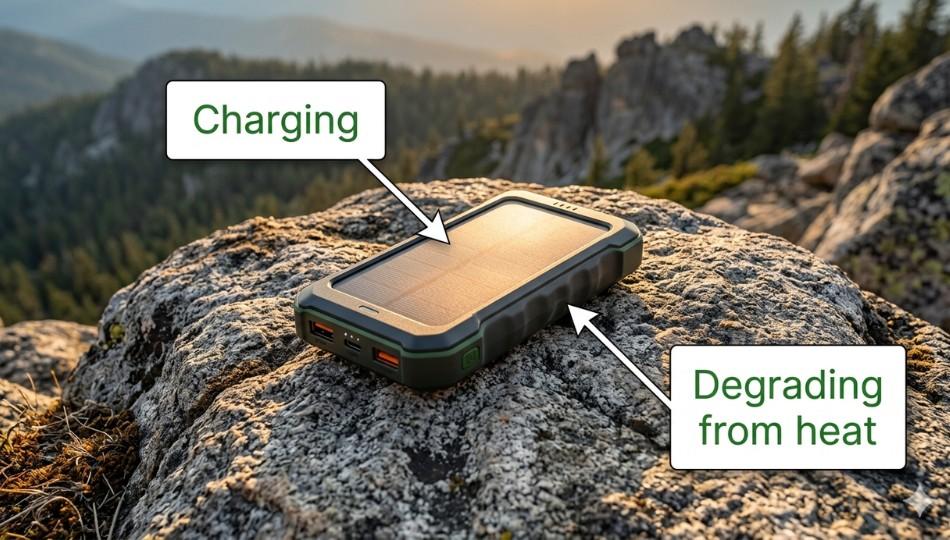
There’s another issue often ignored: heat. Lithium-ion batteries degrade faster under high temperatures. Placing a solar power bank directly on a sun-baked rock can accelerate battery aging and, in extreme cases, pose a safety risk. You are effectively charging and damaging the battery at the same time. Understanding these limitations is crucial before spending your money.
How a Solar Power Bank Actually Works - The HEAT Check Framework
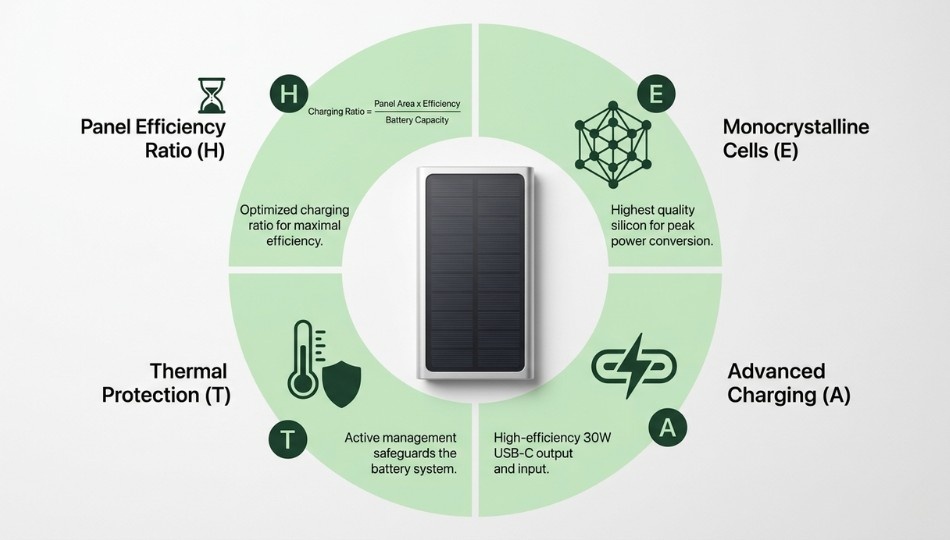
To evaluate solar power banks accurately, I developed the HEAT Check four criteria that determine whether a solar power bank is genuinely useful. I’ve tested over thirty units across three years, and this method consistently separates reliable devices from flashy paperweights.
H - Hours to Recharge (Panel-to-Battery Ratio)
This is the most important metric and the one almost never shown on product pages. You can calculate it by dividing the battery’s watt-hours by the panel’s output.
- Example: A 10,000mAh battery at 3.7V holds about 37Wh. A 2.5W panel would take roughly 15 hours of direct sun to recharge, while a 10W panel would take less than 4 hours.
- My recommendation: the panel wattage should be at least 20–25% of the battery’s watt-hour capacity to make solar charging practical.
E - Efficiency Type (Cell Quality Matters)
Not all solar cells are equal. Monocrystalline panels outperform polycrystalline ones in both sunlight and cloudy conditions. In tests, monocrystalline units produced 40% more current on overcast days compared to polycrystalline units. Always look for “monocrystalline” or “mono-Si” in specifications. Vague claims like “high-efficiency solar” are red flags.
A - Amperage Output (USB-C PD Changes the Game)
When drawing from the stored battery, output speed is crucial. USB-C Power Delivery (PD) can deliver 18W or more, cutting charge times roughly in half compared to standard 5W USB-A ports. This can be a game-changer for travelers or professionals who rely on their devices. Check explicitly for USB-C PD or high-wattage output in the specs.
T - Temperature Management (The Overlooked Factor)
Quality solar power banks include either active thermal management or materials that dissipate heat, such as aluminum, polyester, or nylon. Some devices automatically throttle or pause solar intake above 45°C. Without these protections, repeated exposure to heat will shorten battery life.
IEC 62368-1, the internationally recognized safety standard for electronic devices, recommends thermal safeguards to protect batteries from overheating. For more details, see the IEC standards website.
Solar Power Bank vs. Regular Power Bank - The Honest Comparison
A solar power bank is not automatically better than a regular model. Here’s a practical comparison:
| Feature | Solar Power Bank | Regular Power Bank |
|---|---|---|
| Off-grid recharging | Yes, slow | No |
| Wall charging speed | Similar | Similar or faster |
| Weight | Heavier (panel adds bulk) | Lighter |
| USB-C PD fast charging | Less common | More common |
| Price per mAh | Higher | Lower |
| Pass-through charging | Rare | Common |
| Overheating risk | Higher | Lower |
| Best trip length | 24+ hours off-grid | Under 24 hours |
Pass-through charging – the ability to charge the bank while powering a device is standard on regular power banks but rare on solar models. For trips with limited outlets, this is critical.
Use solar banks when: trips exceed 24 hours and moderate weight is acceptable.
Use regular banks when: trips are under 24 hours, ultralight packing is essential, or wall access is available.
In many cases, pairing a standard power bank with a separate foldable solar panel, like the BigBlue SolarPowa 28, is more efficient than using an integrated solar unit. The all-in-one convenience often comes at the cost of performance.
Busting the mAh Myth
Bigger mAh does not equal better solar performance. A 30,000mAh bank with a 2W panel is less useful than a 10,000mAh bank with a 10W panel. Focus on watt-hours and panel-to-battery ratios rather than the raw mAh figure.
Real-World Use Cases - And Who Should Skip It

A travel blogger on a 10-day Himalayan trek in late 2025 used a solar power bank to charge her phone twice daily and regained about 40% battery mid-day using solar input. She returned with thousands of photos and zero dead devices. The key: consistent sun, moderate daily usage, and a properly sized panel.
Contrast this with someone at a weekend music festival. He set the same device flat in partial shade, expecting full recovery by sunset, and ended up with a nearly dead bank. Different use case, same product expectations matter.
Who Benefits Most
- Multi-day backcountry campers with moderate device use and reliable sunlight
- Emergency preparedness kits for extended outages, where solar functions as a trickle-top-up
- Budget travelers in sunny climates seeking independence from outlets
Who Should Look Elsewhere
- Ultralight backpackers
- People in cloudy regions (Pacific Northwest, UK, Scandinavia)
- Those expecting a full solar recharge in one day
- Laptop users, as most solar banks output 18–30W, insufficient for sustained laptop charging
If your phone drains unusually fast even before leaving home, he problem may not be the external charger at all. Understanding why your iPhone battery turns yellow can help prevent unnecessary purchases.
Five Mistakes That Make Your Solar Power Bank Useless
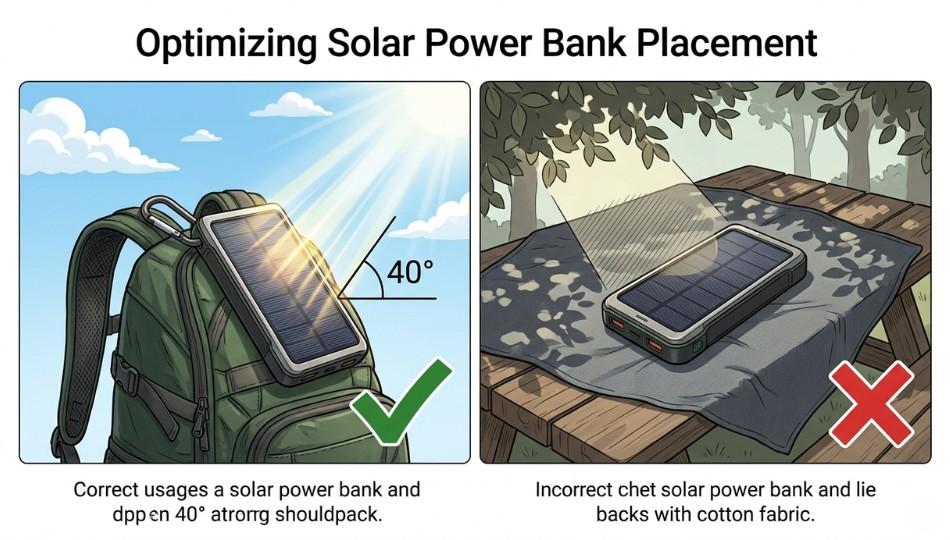
1. Laying it flat
Angle panels 30–45 degrees toward the sun for peak output. Hanging it from a backpack or propping against a rock works best.
2. Buying on mAh alone
Big numbers can be misleading if the panel is weak.
3. Storing discharged
Lithium-ion batteries degrade if left at very low charge for months. Keep devices at 50–80% charge during storage.
4. Ignoring IP ratings
IP65 protects against dust and water jets; IP67 adds brief submersion protection. Lack of an IP rating is risky outdoors.
5. Running devices while solar charging
If draw exceeds solar input, the battery will still lose charge. Charge separately or ensure solar input exceeds usage.
Storing your phone fully discharged or exposing it to heat can reduce long‑term battery health. For tips on how to improve phone battery life, check out this guide.
Before You Buy - Three Key Points
- Run the HEAT Check first. Panel-to-battery ratio determines real-world performance.
- Adjust expectations. Solar power is a backup, not a primary charger.
- For high-demand outdoor use, a standard power bank with a foldable solar panel often outperforms all-in-one units.
Use the HEAT Check, match your use case, and choose wisely.
Frequently Asked Questions
No, only via stored battery. Panels produce too little current for direct charging. Start trips fully charged.
Depends on panel wattage and battery size. A 10W panel on a 10,000mAh bank takes 4–5 hours, while a 2W panel takes 20–25 hours.
They generate 20–40% of clear-sky output under light clouds. Heavy clouds reduce output nearly to zero. Monocrystalline panels perform better in low light.
Repeated high-heat exposure accelerates battery degradation. Keep the battery shaded if possible, or use a unit with thermal throttling.
Most cannot. Laptops require 30–65W while most solar banks output 18–30W. A portable solar power station is better.
Banks up to 100Wh can go in carry-on; 100–160Wh require airline notification. Panels themselves do not add restrictions.
mAh measures charge at a specific voltage; watt-hours provide true energy. Watt-hours are better for comparing devices and calculating recharge times.
10,000–15,000mAh, monocrystalline panel, USB-C PD output, IP-rated. Brands like Goal Zero and BLAVOR balance these factors well.